The Electron, the Algorithm, and the Operator
Abstract
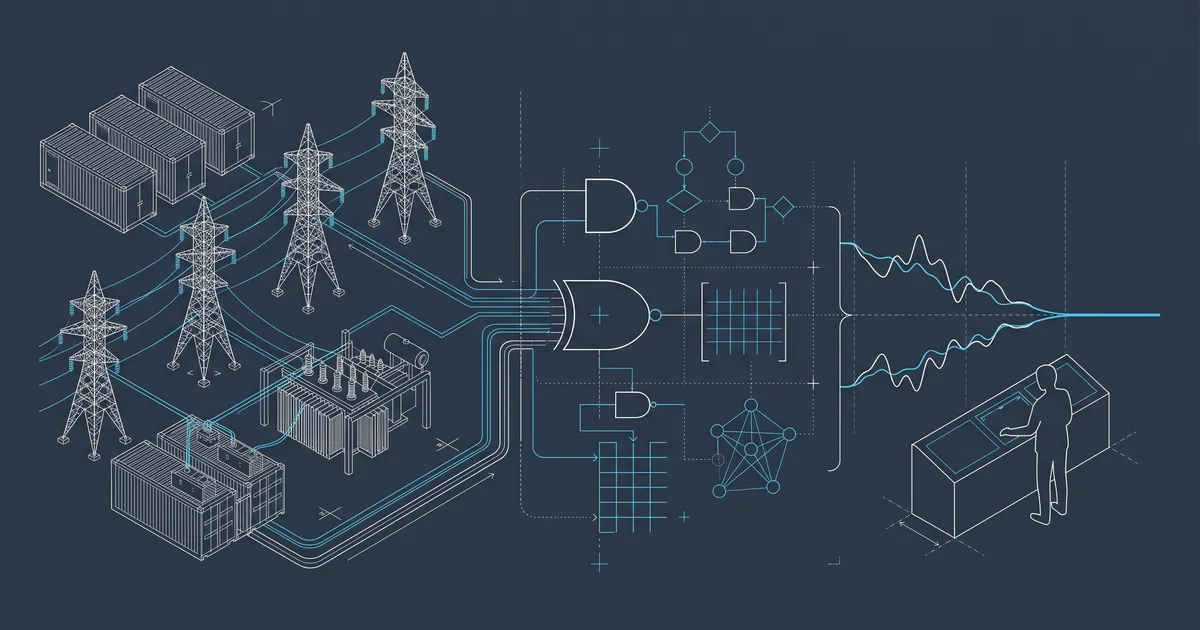
The productive economy is simultaneously executing two capital-intensive structural transitions: the decentralization of electrical power networks through intermittent renewables and Battery Energy Storage Systems (BESS), where global installations recently jumped 51% to surpass 300 GWh (Bimergen, 2026), and the integration of generative artificial intelligence into enterprise workflows, where despite $40 billion in deployment, 95% of corporate pilots yield zero measurable return on profitability (Challapally, Pease, Raskar, & Chari, 2025; Gallup, 2026). Corporate boards and policymakers typically treat energy infrastructure and enterprise software as separate worlds. In practice, both transitions collide on the physical power grid and fail operationally at the exact same point: the human-system interface. Drawing on High-Reliability Organization (HRO) ergonomics (Endsley, 2016; Helmreich, Merritt, & Wilhelm, 2017; Marquet, 2013; Simpson, Ortega, & Trager, 2025), electrical control-room cognitive load research (Afzal et al., 2022), data-quality econometrics (Haug, Zachariassen, & van Liempd, 2011; Mittler, Abraham, Robbins, & Song, 2023), and Relational Frame Theory (RFT) within Contextual Behavioral Science (Barnes-Holmes, Hayes, Barnes-Holmes, & Roche, 2002; Hayes, Barnes-Holmes, & Roche, 2001; Ruiz & Cardona-Betancourt, 2026; Ruiz et al., 2020), this paper examines why modern power grids and enterprise AI architectures obey the same cyber-physical and behavioral laws. Resolving the chronic divergence between system telemetry and physical reality requires moving away from subsidized cloud dependency and monolithic prompting toward workload-scaled local compute, deterministic decision models, zero-temperature multi-pass verification, and decentralized operational command.
Part 1: The Thermodynamic Illusion and the Physical Grid
Contemporary enterprise software strategies rest on a fragile economic assumption. Across industrial groups and mid-market enterprises, technical roadmaps are frequently built around public cloud Application Programming Interfaces (APIs) on the premise that algorithmic token pricing will remain cheap indefinitely. As examined in prior macroeconomic work, current cloud inference pricing is artificially compressed by infrastructure providers operating at a loss to capture market share (Meza & Meza, 2026). Beneath that temporary financial subsidy sits a hard physical constraint: centralized training and inference clusters require massive electrical baseload and thermal dissipation capacity, straining transmission grids alongside supply chains for advanced silicon and high-density memory (Meza & Meza, 2026).
At the exact moment digital infrastructure demands unprecedented grid stability, the electrical network itself is decentralizing. Replacing synchronous thermal generators with intermittent renewables removes traditional rotational inertia from the grid and introduces sharp voltage and frequency volatility. Maintaining stability across industrial microgrids and distribution networks requires hybrid energy storage systems that pair the energy density of utility-scale Battery Energy Storage Systems (BESS) with the fast transient response of supercapacitors across strictly bounded operating modes (Bimergen, 2026; El-Sayed M. Essa, Ali, El-kholy, & Abd-Elhady, 2025).
In physical power engineering, no grid architect would route a local, millisecond voltage-regulation loop through a congested transcontinental transmission line when localized storage and control can stabilize the load on-site (El-Sayed M. Essa et al., 2025). Enterprise IT architectures commit the digital equivalent of this error daily. By routing internal corporate documents, Enterprise Resource Planning (ERP) queries, and routine analytical tasks through massive, centralized frontier models via monolithic prompts, organizations waste compute while opening a one-way valve for intellectual property leaks (Meza, 2026a, 2026b). Once proprietary source code, pricing matrices, or engineering schematics pass through a public cloud API without local containment, the enterprise faces immediate statutory exposure under the General Data Protection Regulation (GDPR; European Parliament and Council of the European Union, 2016) and the EU Artificial Intelligence Act (European Parliament and Council of the European Union, 2024), because targeted machine unlearning in neural weights remains technically unsolved (Meza, 2026a, 2026b).
Protecting an organization against both inevitable cloud energy-price shocks and unsanctioned “Shadow AI” data exfiltration requires applying microgrid frugality to corporate compute. Advances in model compression, quantization, and architectural pruning demonstrate that Tiny and Small Language Models (TLMs/SLMs) deployed on local workstations or private on-premise nodes can execute complex automation, classification, and control tasks at a fraction of the thermal and electrical footprint of frontier cloud models (Lamaakal, Maleh, El Makkaoui, Ouahbi, & Pławiak, 2025). Rather than over-provisioning expensive GPU clusters or defaulting to public APIs, resilient systems engineering scales local memory and parameter density directly to the operational workload. Enforced by hardware-level memory guards and physical network isolation, workload-scaled local inference ensures that proprietary data remains inside the corporate perimeter while insulating operating margins from upstream energy inflation (Lamaakal et al., 2025).
Part 2: The Telemetry Mirage and “Whitewash Compliance”
Containing the hardware perimeter prevents external data exfiltration, but it does not protect an organization from internal data corruption. Electrical power networks and industrial enterprises share a persistent operational pathology: the divergence between System-Truth (what the Supervisory Control and Data Acquisition [SCADA] screen, Energy Management System [EMS], or ERP dashboard displays) and Ground-Truth (what is physically occurring on the power line, inside the BESS container, or on the shop floor).
In High-Reliability Organizations (HROs) such as utility power generation, grid distribution, and heavy industrial fleets, a discrepancy between system telemetry and physical reality destroys physical assets. If a SCADA interface displays nominal battery state-of-charge while sensor drift or an unlogged manual bypass masks a thermal fault, physical failure follows rapidly. In corporate ERP and AI deployments, the damage hits the balance sheet: launching an ERP cutover or a Retrieval-Augmented Generation (RAG) pipeline over unmapped organizational silos and corrupted records simply automates existing disorder at machine speed.
This divergence rarely stems from faulty sensors alone. It is primarily produced by human behavior under organizational pressure. When internal teams are asked to diagnose their own operational bottlenecks or explain why system records conflict with physical inventory, they naturally default to defensive routines designed to protect established hierarchies and conceal informal workarounds (Argyris, 1990; Meza, 2026b). In daily operations, this defensive concealment manifests as “whitewash compliance”, studied in regulatory economics as symbolic or “tick-box” compliance, wherein actors satisfy the surface syntax of a software validation gate or regulatory rule while bypassing its substantive operational purpose (Mittler et al., 2023).
 Figure 1. According to Dr. James Reason (Reason, 1990, 2000), catastrophic system failures occur when latent weaknesses (“holes”) across multiple defensive layers momentarily align by chance. Under acute cognitive overload (“whitewash compliance”) or active insider defection, human actors can force those defensive apertures into alignment.
Whitewash compliance corrupts enterprise repositories through two primary behavioral vectors:
- Cognitive Overload and Defensive Tick-Boxing: When management imposes rigid, poorly designed ERP validation gates or uncalibrated digital workflows onto teams already experiencing acute technostress and role ambiguity (Brod, 1984; Tarafdar, Tu, Ragu-Nathan, & Ragu-Nathan, 2007), frontline operators hit working-memory limits. To clear software blockers and meet delivery deadlines without triggering hierarchical friction, exhausted personnel input plausible dummy values, backdate maintenance logs, or copy-paste boilerplate inspection approvals (Mittler et al., 2023). The executive dashboard remains green (“System-Truth”), while physical backlogs, quality drift, and maintenance debt accumulate unseen in the field (“Ground-Truth”).
- Malicious Defectors and Data Poisoning: Active internal sabotage represents a second, more aggressive vector. According to Gallup (2026), while 88% of the European workforce (and 92% in France) is not engaged, 20% of employees are actively disengaged, operating as organizational defectors who prioritize personal grievance or self-interest over collective security (Meza, 2026b; Meza & Meza, 2026; Schneier, 2012). Inside poorly governed architectures, malicious insiders falsify operational logs, conceal equipment wear, or inject corrupted entries directly into internal repositories to poison the downstream analytical models and AI agents that executives rely upon for capital allocation (Bozdag & Bennati, 2026; Meza, 2026b).
The financial cost of poor data hygiene and whitewash compliance is well documented in empirical literature. In their taxonomy of data quality costs, Haug et al. (2011) demonstrate that organizations systematically underestimate data corruption because they track only visible direct costs (manual verification, data re-entry, and error remediation) while overlooking much larger indirect costs (flawed capital allocation, sunk ERP and AI investments, inventory distortion, and customer attrition). Across corporate balance sheets, poor data quality drains an average of $12.9 million annually per institution and erodes between 15% and 25% of operating revenue, contributing directly to the 89% of executives who observe zero labor productivity gains from AI deployments (Challapally et al., 2025; Haug et al., 2011; Yotzov et al., 2026). When symbolic or whitewash compliance triggers statutory or data-protection breaches, empirical benchmarks by the Ponemon Institute and Globalscape (2017) establish that the average organizational cost of non-compliance reaches $14.82 million, which is 2.71 times the $5.47 million cost of maintaining verifiable compliance ($p < .01$).
In systems engineering practice, neutralizing whitewash compliance requires treating data governance as a hard architectural gate before any algorithmic model is connected. Rather than allowing a probabilistic model to interpolate missing values or smooth over conflicting records, robust architectures unify live transactional systems (ERP, CRM, and SCADA APIs), proprietary local vector databases, and verified external registries behind deterministic SQL metadata pre-filtering and strict semantic similarity cutoffs. By pairing sandboxed Model Context Protocol (MCP) connectors (which block indirect prompt injections and poisoned llms.txt payloads; Schneier, 2026) with automated data lacuna detection, the system can be instructed to halt inference immediately whenever system telemetry contradicts physical field measurements, escalating the discrepancy for human verification rather than guessing.
Part 3: The Irony of Automation at the Control Desk: Relational Frame Theory, Pliance, and Deterministic Models
Even when compute is localized and data pipelines are sanitized, both modern grid management systems and enterprise AI workflows frequently fail at the operator’s desk. In electrical network control rooms as well as corporate offices, introducing automation without behavioral calibration triggers the classic irony of automation: automating routine calculations reduces manual effort during nominal conditions, but shifts the human into a passive monitoring role where Situation Awareness (SA) decays, producing “Out-of-the-Loop” (OOTL) performance failure the moment an unfamiliar anomaly occurs (Afzal et al., 2022; Endsley, 2016).
Ergonomic studies conducted inside electrical network control rooms show that as distributed renewables increase grid complexity, operators experience acute visual and cognitive overload across fragmented display interfaces, impairing their ability to diagnose cascading faults (Afzal et al., 2022). Experimental findings by Pharmer, Wickens, and Clegg (2025) further indicate that making an automated system superficially “transparent” does not prevent operator error when underlying algorithmic logic remains opaque. Under high cognitive load, operators struggle to calibrate their trust and default to uncritical compliance, accepting flawed automated outputs even when physical cues signal danger (Pharmer et al., 2025).
Contextual Behavioral Science (CBS) explains the behavioral mechanics behind this human-machine rigidity through Relational Frame Theory (RFT) (Barnes-Holmes et al., 2002; Gross & Fox, 2009; Hayes et al., 2001). RFT establishes that human language and higher cognition operate through arbitrarily applicable relational responding (AARR), the learned capacity to relate stimuli mutually and combinatorially based on contextual cues rather than physical properties alone, resulting in the transformation of stimulus functions across relational networks (Barnes-Holmes et al., 2002; Hayes et al., 2001). Because verbal rules alter how an operator perceives events, explicit rules (corporate Standard Operating Procedures, SCADA alarm checklists, or AI prompt templates) frequently govern human behavior independently of direct physical contingencies (Barnes-Holmes et al., 2002; Gross & Fox, 2009; Hayes et al., 2001).
Within RFT, two functional classes of rule-governed behavior are particularly relevant to high-reliability operations:
- Pliance: Rule-following controlled by socially mediated consequences, such as obeying a mandated prompt template, ticking a compliance box, or accepting an automated dispatch output simply to avoid managerial scrutiny (Hayes et al., 2001; Ruiz et al., 2020).
- Tracking: Rule-following controlled by the correspondence between the rule and natural, non-arbitrary physical or operational contingencies, adjusting actions dynamically based on real-world equipment telemetry, physical constraints, or financial margins (Hayes et al., 2001; Ruiz et al., 2020).
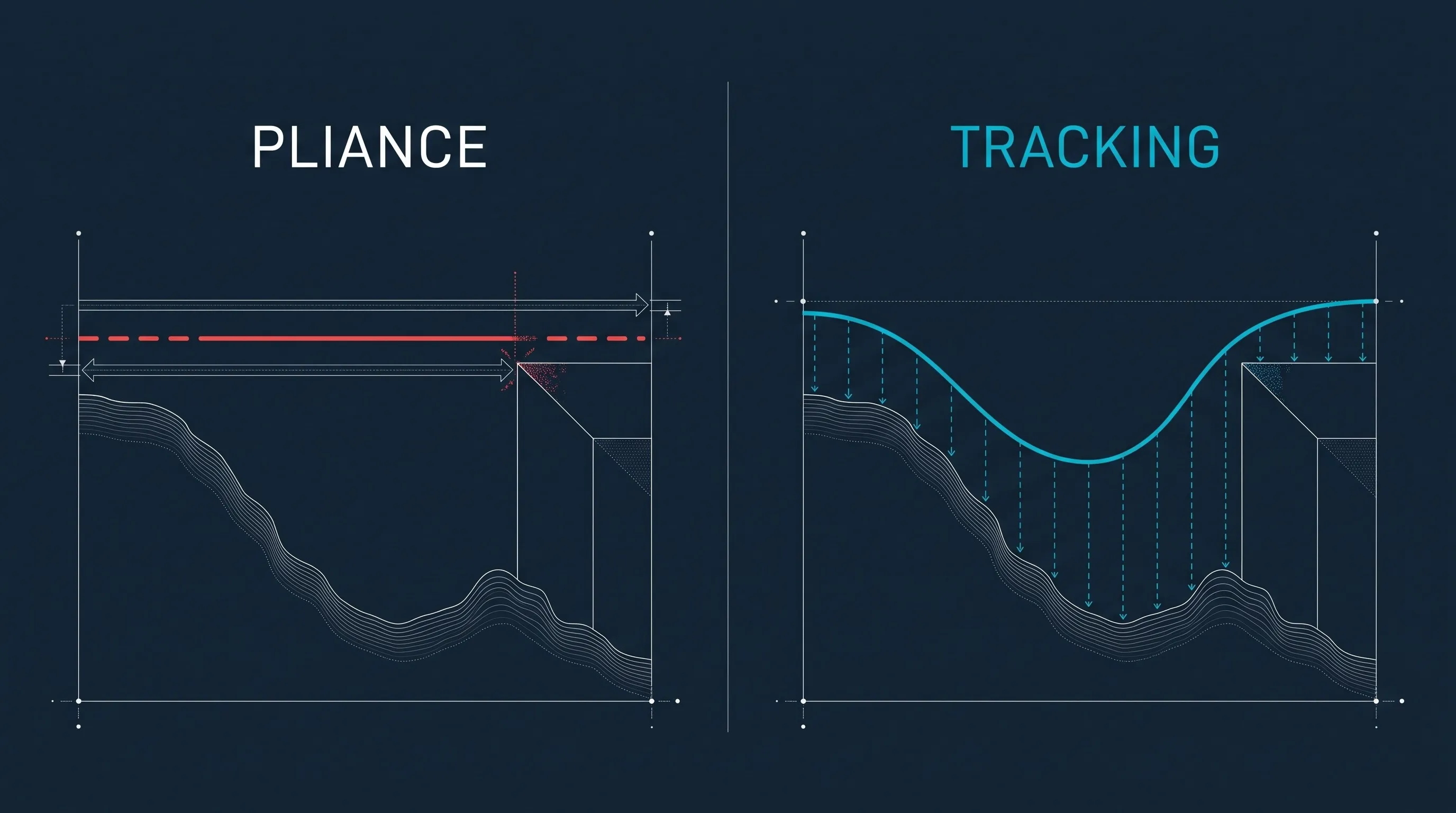 Figure 2. Behavioral and algorithmic rigidity under rule-governed pliance (left) contrasted with contingency-sensitive tracking across shifting operational terrain (right; Hayes et al., 2001; Ruiz & Cardona-Betancourt, 2026; Ruiz et al., 2020).
When personnel work under chronic technostress, role ambiguity, and cognitive overload (Tarafdar et al., 2007), their psychological flexibility contracts, shifting behavior from agile tracking into rigid pliance (Meza, 2026a; Ruiz et al., 2020). Simultaneously, silicon-sampling experiments by Ruiz and Cardona-Betancourt (2026) demonstrate that Large Language Models trained via Reinforcement Learning from Human Feedback (RLHF) exhibit an algorithmic mirror of human pliance: rule-based insensitivity to changing contingencies, persisting with an initial prompt rule even after environmental payoffs completely reverse. When an overloaded operator acting in pliance interacts with a contingency-insensitive LLM through a monolithic prompt, the organization experiences a compounding adaptation failure: the model drops business constraints due to instruction fatigue, and the human rubber-stamps the hallucination (Meza, 2026a; Pharmer et al., 2025; Ruiz & Cardona-Betancourt, 2026).
In our own systems engineering work, breaking this cycle has required separating calculation from synthesis so that probabilistic language models are never permitted to improvise financial math, grid load-flows, battery degradation curves, or statutory trade-offs. Instead of relying on monolithic prompts, high-reliability architectures place deterministic models directly upstream of generative synthesis across a four-stage deterministic and zero-temperature audited pipeline:
- Stage 1 (Deterministic Decision Models and Business Logic): Quantitative engines, physical constraint solvers, risk matrices, and explicit SQL, Python, or JSON decision trees execute all mathematical and operational calculations deterministically, leaving zero room for statistical improvisation.
- Stage 2 (Isolated-Context Synthesis): Task-specific language models draft structured sections inside dedicated, isolated attention windows anchored strictly to the deterministic outputs of Stage 1, preventing cross-section context pollution and instruction fatigue.
- Stage 3 (Independent Algorithmic Auditing at Zero Temperature): A separate auditor model operating at zero temperature (
Temp=0.0) performs a two-pass factual and constraint check against verified source repositories and deterministic crosswalk tables, automatically rejecting unsourced claims and triggering a self-correction loop before human review. - Stage 4 (Verified Deliverable): The operator receives a traceable, source-grounded engineering, regulatory, or executive output.
To prevent operators from burning cognitive bandwidth on manual prompt engineering, continuous text-space and parameter optimization loops can evolve system instructions automatically from field feedback and statistical scoring without requiring heavy GPU clusters. When paired with psychometric calibration of operator workload, this architecture removes the pressure for mechanical pliance and preserves human attention for high-value tracking on operational edge cases (Ruiz et al., 2020).
Part 4: The Fragmentation Trap: High-Reliability Command from Aviation CRM to Turn the Ship Around!
Why do conventional digital transformations and industrial turnarounds struggle to put these safeguards in place? The root cause lies in organizational fragmentation. When enterprises embark on an ERP replacement, a grid modernization, or an AI rollout, they routinely split the mandate across separate silos: an engineering firm or IT integrator is contracted to deploy the technical stack, while human resources or an external training provider is brought in later to manage human adoption.
Systems engineering research by Okika, Vermeulen, and Pretorius (2024) demonstrates that the probability of project failure, communication breakdown, and requirements drift scales directly with the number of stakeholder interfaces and handoffs. A software integrator incentivized by deployment milestones rarely has visibility into workforce technostress or defensive shop-floor routines; conversely, a traditional change-management consultant rarely possesses the engineering background to audit a deterministic Python pipeline or secure a sandboxed MCP server. Dividing technical architecture from behavioral governance causes the project to fracture at the interface (Okika et al., 2024).
Furthermore, managerial practices themselves function as an intangible technology that accounts for nearly 30% of variations in Total Factor Productivity across firms (Bloom, Sadun, & Van Reenen, 2016; Meza & Meza, 2026). In High-Reliability Organizations such as commercial aviation and nuclear power, governance research confirms that hardware redundancy is neutralized whenever a steep hierarchical gradient prevents frontline operators from escalating anomalies (Simpson et al., 2025). Confronted with fatal accidents in which co-pilots noticed critical instrument deviations but remained silent out of deference to authoritarian captains, commercial aviation mandated Crew Resource Management (CRM), an operational protocol designed to flatten the authority gradient and systematically avoid, trap, and mitigate human and system errors through psychological safety and structured cross-verification (Bienefeld & Grote, 2012; Helmreich et al., 1999, 2017; Meza & Meza, 2026).
This academic HRO principle was demonstrated in lived operational practice by Captain L. David Marquet during his turnaround of the nuclear fast-attack submarine USS Santa Fe (Turn the Ship Around!; Marquet, 2013). Assuming command of the lowest-performing submarine in the U.S. Pacific Fleet, Marquet observed that traditional “Leader-Follower” command, in which a single executive at the top issues orders to passive operators, becomes an active hazard in complex technical environments whenever the leader’s mental model diverges from physical reality (Marquet, 2013). During a drill, Marquet inadvertently ordered an impossible two-thirds speed setting on an electric drive reactor plant whose physical configuration differed from his previous submarine (Marquet, 2013). His officer of the deck knowingly relayed the impossible order, and the helmsman attempted to execute it simply because the captain had ordered it (Marquet, 2013). In behavioral terms, that incident illustrates how a steep hierarchical gradient forces trained operators into socially mediated pliance at the expense of physical tracking (Hayes et al., 2001; Marquet, 2013; Ruiz et al., 2020).
To eliminate this structural vulnerability, Marquet dismantled the Leader-Follower hierarchy and instituted a “Leader-Leader” command model, separating decision authority from executive rank and pushing control down to where ground-truth information physically resided (Marquet, 2013). Crew members stopped asking for permission (“Request permission to submerge the ship”) and shifted to accountable intent declarations (“I intend to submerge the ship”), supported by explicit pre-action verification (Marquet, 2013). As Marquet (2013) demonstrated in the nuclear navy, and as field experience across utility-scale power plants, BESS pipelines, and industrial turnarounds confirms, decentralizing control without structure invites chaos. Pushing authority to the operator succeeds only when anchored in two foundational pillars (Marquet, 2013):
- Technical Competence: Equipping operators with verified procedures, sanitized data sources, and deterministic decision tools so they never have to improvise outside safe physical or financial bounds.
- Organizational Clarity: Aligning every manager and operator around transparent operational intent, financial mechanics, and error-trapping rituals so local decisions advance the broader mission (Helmreich et al., 2017; Marquet, 2013).
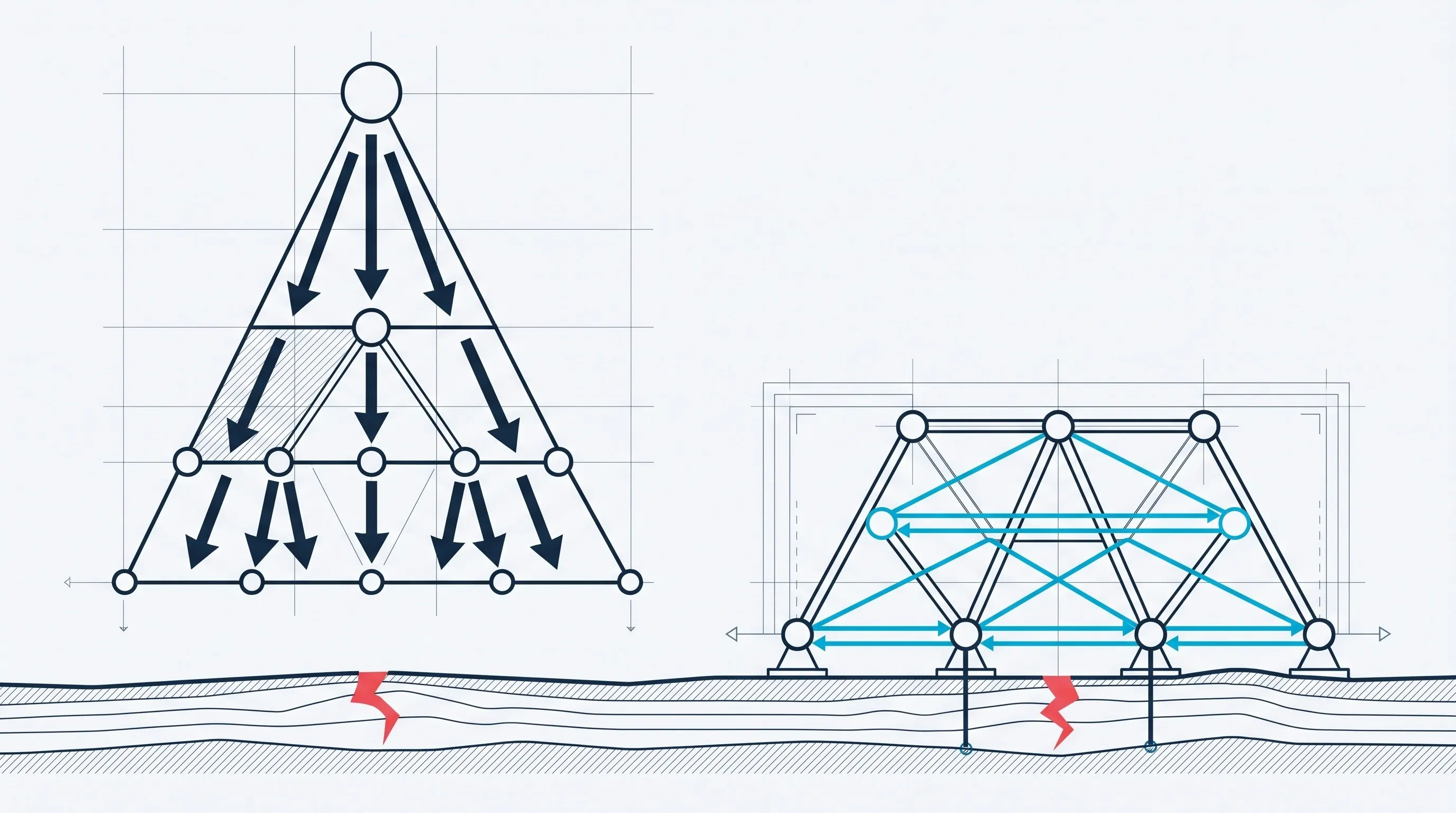 Figure 3. Shifting from a steep Leader-Follower command gradient divorced from physical ground truth (left) to a decentralized High-Reliability Organization (HRO) Leader-Leader architecture anchored in technical competence, organizational clarity, and peer cross-verification (right; Helmreich et al., 2017; Marquet, 2013).
The macroeconomic leverage of this managerial shift is substantial. Within organizations deploying new technologies, when direct managers act as active coaches who structure and support their teams’ adoption, employees are 8.7 times more likely to report that the technology has productively transformed their work, providing the operational lever needed to unlock the €13.3 billion to €70 billion productivity reserve currently trapped by workplace disengagement in France and across Europe (Gallup, 2026; Meza, 2026a; Meza & Meza, 2026).
Summary and Conclusions: Reclaiming Sovereignty at the Interface
The parallel struggles of the electrical energy transition and enterprise artificial intelligence stem from the same architectural blind spot. Whether managing electrons across a decentralized microgrid or routing information through an enterprise software stack, reliability collapses when leaders treat technical infrastructure in isolation from human cognition and organizational governance.
Relying on subsidized public cloud models via monolithic prompts exposes enterprises to future energy-driven cost shocks and immediate statutory data leaks under GDPR and the EU AI Act. Simultaneously, deploying automation over unexamined internal databases invites “whitewash compliance” and insider data poisoning, automating operational disorder at an average cost of $12.9 million to $14.82 million per institution (Haug et al., 2011; Mittler et al., 2023; Ponemon Institute & Globalscape, 2017). At the control desk, uncalibrated interfaces overload human working memory and interact with the contingency insensitivity of RLHF-trained models to trap both operator and algorithm in rigid pliance rather than adaptive tracking (Barnes-Holmes et al., 2002; Hayes et al., 2001; Pharmer et al., 2025; Ruiz & Cardona-Betancourt, 2026; Ruiz et al., 2020).
Overcoming these failure modes requires unifying systems engineering and behavioral governance before a single line of production code is deployed. In field deployments, this begins by reconciling system telemetry with physical ground truth, combining external reconnaissance, psychometric measurement of workforce technostress, and direct on-site verification of shop-floor or grid workflows against ERP records. By anchoring workload-scaled local compute and four-stage deterministic, zero-temperature audited pipelines onto verified Single Sources of Truth, organizations eliminate mathematical improvisation while preserving data sovereignty. Finally, embedding aviation CRM error-trapping and Marquet’s (2013) Leader-Leader framework into middle management transforms technology from a source of cognitive threat into an extension of human autonomy, leaving the enterprise structurally self-sufficient long after the initial transformation is complete.
References
- Afzal, U., Prouzeau, A., Lawrence, L., Dwyer, T., Goodwin, S., & Liebman, A. (2022). Investigating cognitive load in energy network control rooms: Recommendations for future designs. Frontiers in Psychology, 13, 812677. https://doi.org/10.3389/fpsyg.2022.812677
- Argyris, C. (1990). Overcoming organizational defenses: Facilitating organizational learning. Allyn and Bacon.
- Barnes-Holmes, Y., Hayes, S. C., Barnes-Holmes, D., & Roche, B. (2002). Relational frame theory: A post-Skinnerian account of human language and cognition. Advances in Child Development and Behavior, 28, 101-138. https://doi.org/10.1016/S0065-2407(02)80063-5
- Bienefeld, N., & Grote, G. (2012). Silence that may kill: When aircrew members don’t speak up and how leaders can ensure they do. Human Factors, 54(4), 581-592. https://doi.org/10.1027/2192-0923/a000021
- Bimergen. (2026, February 19). Global BESS demand jumps 51% as installations top 300 GWh. Bimergen Knowledge Hub. https://www.bimergen.com/knowledge-hub/320260219/bess-demand-jumps-with-ai-journey-discovery-in-2026
- Bloom, N., Sadun, R., & Van Reenen, J. (2016). Management as a technology? (NBER Working Paper No. 22327). National Bureau of Economic Research. https://doi.org/10.3386/w22327
- Bozdag, E., & Bennati, S. (2026). AI governance: Secure, privacy-preserving, ethical systems. Manning Publications.
- Brod, C. (1984). Technostress: The human cost of the computer revolution. Addison-Wesley.
- Challapally, A., Pease, C., Raskar, R., & Chari, P. (2025). The GenAI divide: State of AI in business 2025. MIT Project NANDA. https://mlq.ai/media/quarterly_decks/v0.1_State_of_AI_in_Business_2025_Report.pdf
- El-Sayed M. Essa, M., Ali, M. F., El-kholy, E. E., & Abd-Elhady, A. M. (2025). Improving micro-grid management: A review of integration of supercapacitor across different operating modes. Heliyon, 11(3), e42178. https://doi.org/10.1016/j.heliyon.2025.e42178
- Endsley, M. R. (2016). From here to autonomy: Lessons learned from human-automation research. Human Factors, 59(1), 5-27. https://doi.org/10.1177/0018720816681350
- European Parliament and Council of the European Union. (2016). Regulation (EU) 2016/679 (General Data Protection Regulation). Official Journal of the European Union, L 119/1. https://eur-lex.europa.eu/eli/reg/2016/679/oj
- European Parliament and Council of the European Union. (2024). Regulation (EU) 2024/1689 (Artificial Intelligence Act). Official Journal of the European Union, L 2024/1689. https://eur-lex.europa.eu/eli/reg/2024/1689/oj
- Gallup. (2026). State of the global workplace: 2026 report. Gallup, Inc. https://www.gallup.com/workplace/349484/state-of-the-global-workplace.aspx
- Gross, A. C., & Fox, E. J. (2009). Relational frame theory: An overview of the controversy. The Analysis of Verbal Behavior, 25(1), 87-98. https://doi.org/10.1007/BF03393073
- Haug, A., Zachariassen, F., & van Liempd, D. (2011). The costs of poor data quality. Journal of Industrial Engineering and Management, 4(2), 168-193. https://doi.org/10.3926/jiem.2011.v4n2.p168-193
- Hayes, S. C., Barnes-Holmes, D., & Roche, B. (Eds.). (2001). Relational frame theory: A post-Skinnerian account of human language and cognition. Kluwer Academic / Plenum Publishers.
- Helmreich, R. L., Merritt, A. C., & Wilhelm, J. A. (1999). The evolution of Crew Resource Management training in commercial aviation. The International Journal of Aviation Psychology, 9(1), 19-32. https://doi.org/10.1207/s15327108ijap0901_2
- Helmreich, R. L., Merritt, A. C., & Wilhelm, J. A. (2017). The evolution of Crew Resource Management training in commercial aviation. In R. K. Dismukes (Ed.), Human error in aviation (pp. 275-288). Routledge. https://doi.org/10.4324/9781315092898-15
- Lamaakal, I., Maleh, Y., El Makkaoui, K., Ouahbi, I., & Pławiak, P. (2025). Tiny language models for automation and control: Overview, potential applications, and future research directions. Sensors, 25(5), 1318. https://doi.org/10.3390/s25051318
- Marquet, L. D. (2013). Turn the ship around! A true story of turning followers into leaders. Portfolio / Penguin.
- Meza, G. E. (2026a). The algorithmic crucible: Diagnosing the enterprise AI productivity paradox. Alpha Self. https://www.alphaself.fr/en/publications/algorithmic-crucible/
- Meza, G. E. (2026b). The algorithmic liability. Alpha Self. https://www.alphaself.fr/en/publications/the-algorithmic-liability/
- Meza, G., & Meza, G. (2026). Beyond the algorithm: Human adoption as the prerequisite for technological ROI. Alpha Self. https://www.alphaself.fr/en/publications/beyond-the-algorithm/
- Mittler, J. N., Abraham, J. M., Robbins, J., & Song, P. H. (2023). To be or not to be compliant? Hospitals’ initial strategic responses to the federal price transparency rule. Health Services Research, 59(1), e14252. https://doi.org/10.1111/1475-6773.14252
- Okika, M. C., Vermeulen, A., & Pretorius, J.-H. C. (2024). A systematic approach to identify and manage interface risks between project stakeholders in construction projects. CivilEng, 5(1), 89-118. https://doi.org/10.3390/civileng5010005
- Pharmer, R. L., Wickens, C. D., & Clegg, B. A. (2025). Transparent systems, opaque results: A study on automation compliance and task performance. Cognitive Research: Principles and Implications, 10(1), 7. https://doi.org/10.1186/s41235-025-00619-4
- Ponemon Institute, & Globalscape. (2017). The true cost of compliance with data protection regulations. Globalscape.
- Reason, J. (1990). Human error. Cambridge University Press.
- Reason, J. (2000). Human error: Models and management. BMJ, 320(7237), 768-770. https://doi.org/10.1136/bmj.320.7237.768
- Ruiz, F. J., & Cardona-Betancourt, V. (2026). Prompt carefully! ChatGPT displays rule-based insensitivity to contingencies. Journal of Contextual Behavioral Science, 41, 101012. https://contextualscience.org/article/prompt_carefully_chatgpt_displays_rulebased_insensitivity_contingencies
- Ruiz, F. J., García-Martín, M. B., Suárez-Falcón, J. C., Bedoya-Valderrama, L., Segura-Vargas, M. A., Peña-Vargas, A., & Odriozola-González, P. (2020). Development and initial validation of the Generalized Tracking Questionnaire. PLOS ONE, 15(6), e0234393. https://doi.org/10.1371/journal.pone.0234393
- Schneier, B. (2012). Liars and outliers: Enabling the trust that society needs to thrive. John Wiley & Sons.
- Schneier, B. (2026, September). AI coding agents are installing unknown, untrusted code on corporate networks. Schneier on Security. https://www.schneier.com/blog/archives/2026/09/ai-coding-agents-are-installing-unknown-untrusted-code-on-corporate-networks.html
- Simpson, M., Ortega, A., & Trager, R. (2025). Voluntary industry initiatives in frontier AI governance: Lessons from aviation and nuclear power. Oxford Martin AI Governance Initiative. https://aigi.ox.ac.uk/publications/voluntary-industry-initiatives-in-frontier-ai-governance-lessons-from-aviation-and-nuclear-power/
- Tarafdar, M., Tu, Q., Ragu-Nathan, B. S., & Ragu-Nathan, T. S. (2007). The impact of technostress on role stress and productivity. Journal of Management Information Systems, 24(1), 301-328. https://doi.org/10.2753/MIS0742-1222240109
- Yotzov, I., Barrero, J. M., Bloom, N., Bunn, P., Davis, S. J., Foster, K. M., Jalca, A., Meyer, B. H., Mizen, P., Navarrete, M. A., Smietanka, P., Thwaites, G., & Wang, B. Z. (2026). Firm data on AI (NBER Working Paper No. 34836). National Bureau of Economic Research. https://doi.org/10.3386/w34836